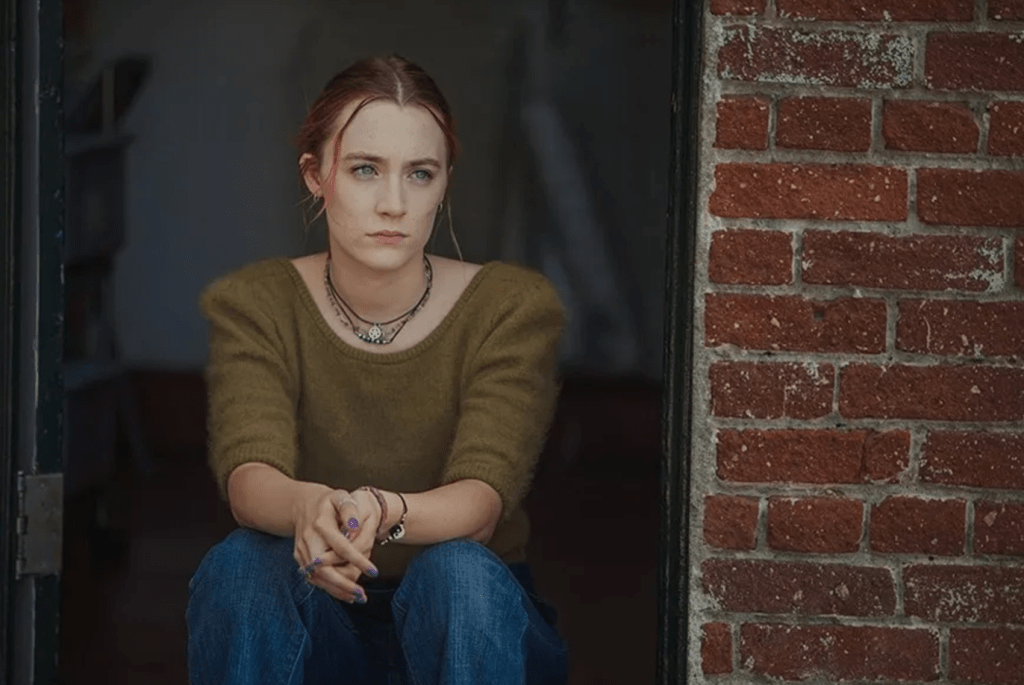
Greta Gerwig’s directorial debut. I find myself coming back to this movies 6 years after graduating high school.
Set in 2002- 2003, Lady Bird is a partially autobiographical film based on director Greta Gerwig’s coming of age story her senior year of high school. Instead of a dramatic plot development, Greta Gerwig’s movies use dialogue to create a certain rhythm between characters. In one of her interviews, Gerwig explains how she approaches directing as conducting an orchestra. Instead of focusing so much on what the actors are doing on screen, she listens to the scene to hear how the words and tone clash and reunite.
Christine, aka Lady Bird (she gave herself that name) is a high school senior at Immaculate Heart (an all girls catholic school) in Sacramento, California. The story follows Lady Bird’s last year of high school as she navigates relationships with herself, boys, friends, and especially with her strong-willed mother, Marion.
Lady Bird feels guilt for pursuing what she wants even if it’s beyond her family’s means but also needs to do what she wants. Marion loves Lady Bird but is not great at acknowledging that she sees the best in her. Like any mom, Marion wishes Lady Bird to be an even better version of herself. She sews Lady Bird’s dress and enjoys her company but is also stubborn and can be sharp with her words.
Scenes with Lady Bird and her mother start slow and quickly escalates into a nasty argument between the two. Lady Bird is ashamed of the fact she grew up from the “wrong side of train tracks”. Marion, Lady Bird’s mother, is disappointed Lady Bird feels ashamed of where the family lives. Lady Bird wants to go to New York University after graduating high school and leave Sacramento. Marion is frustrated by Lady Bird’s stubbornness to attend a high-costing school knowing the family can’t support her financially. Meanwhile, Larry, Lady Bird’s dad stays the good cop, always understanding Lady Bird’s point of view. Yet at the end, Marion is the one Lady Bird calls after leaving Kyle’s place and Marion is the one who tailors Lady Bird’s prom dress to make sure it fits her perfectly. Despite the heavy miscommunication, disappointment, and frustration two people can share, they always find their way back to each other.
I thought this movie was just as much of a coming of age for Lady Bird as it was for Marion. I especially felt this in the scene where Marion drives away from the airport after silently dropping off Lady Bird at the airport as she left for New York. When Marion found out Lady Bird applied to NYU behind her back she decided to ignore Lady Bird and not speak to her. On her drive back from the airport Marion drives in silence as tears well up in her eyes, and makes a sharp u-turn as when she realizes she regretted her decision. By the time she arrives back to the airport, Lady Bird had left. At the very end of the movie, Lady Bird walks into a catholic church in New York and calls her parents, addressing herself as Christine, the name her parents gave her.
Lady Bird reminds us of the constant battle we had between being ourselves and being “cool” growing up. Lady Bird goes back and forth between those two identities. At age 18, it’s easy to assume you know what is best for you and what is best for others. We think we know who we should date, who we should befriend, and where we should go for college. Although not all of Lady Bird’s decisions were very commendable, I did admire her boldness. Her decision to ask out Danny, talk to Kyle, join the theater, and to name herself Lady Bird all came with no hesitance. Lady Bird uses her naivety as a source of courage through this transitional phase of her life; a privilege that comes with youth. Lady Bird represents the growing pains of entering adulthood and proves how there is always good things that eventually come out of it.

 Midnight salon